マーケット
2026年見通し:オルタナティブ投資を活用した分散を検討すべき理由マーケット / 全般
2026年見通し:オルタナティブ投資を活用した分散を検討すべき理由
2025年11月20日
不確実なマクロ環境下で、投資家はオルタナティブに注目
テクノロジーセクターが牽引し、第3四半期も株式市場およびその他リスク資産は上昇を続けました。主要株価指数は過去最高値を更新し、テック投資熱、米連邦準備制度理事会(FRB)の利下げ観測、そして堅調な企業収益が相場を押し上げました。特に人工知能(AI)投資への期待が上昇の主因となり、ハイテク比率の高いナスダックは他の主要指数を上回る伸びを見せましたが、その一方で集中リスクへの懸念も高まっています。
一方で、株価は割高です。株式バリュエーションは長期平均を上回り、指標によっては歴史的な割高水準にあります。それでも企業利益は力強く、一部の高いバリュエーションを正当化する内容となっています。
FRBは金利を引き下げましたが、その水準はなお近年より高い状態が続いています。インフレが概ね抑制されつつも景気減速の兆候がみられる中で、FRB は9月と10月にそれぞれ0.25%の利下げを実施しましたが、金利は依然として高水準です。
経済環境は「楽観」と「慎重」が入り混じっています。一見すると、市場環境は良好に見えます。インフレはわずかに上昇し、労働市場にもやや減速の兆しがあるものの、経済は概ね堅調で、個人消費も強い状態が続いています。しかし注意深く見ると、成長鈍化を示すサインが表れ始めており、過度な楽観は抑えられます。加えて地政学リスクも依然残り、関税の影響は現時点では限定的なものの、多くのエコノミストは「本格的な影響は今後数カ月で表れる」と見ています。
こうした中、第4四半期から2026年に向けて、オルタナティブ投資によるポートフォリオ分散の重要性は一層高まっています1。投資家は分散、インカム向上、インフレヘッジ、リターン強化を求めており、オルタナティブ投資は2026年において重要な役割を果たすと当社では考えています。
このオルタナ四半期レポート最新号では、2026年に向けてオルタナティブ投資が投資家にどのような重要な役割を果たすのか、そして当社チームが観察してきた複数のテーマについて、オルタナ研究所の見解とともに探ります。
具体的には以下を取り上げます:
- プライベート・クレジット:より多くの投資家が同資産クラスの組み入れを行うかなで、プライベート・クレジットが転換点を迎えている点と、オルタナティブ・クレジットの3本柱のバランスをどのように考えるべきかを解説します。
- プライベート不動産:過去水準を上回る高金利を背景に不動産デットの利回りが依然として魅力的であること、そして金利低下局面への移行が取引活動を押し上げ、相対的に低い不動産バリュエーションと相まって、投資機会が広がっている点を考察します。
- インフラストラクチャー(インフラ):デジタル化、脱炭素化、脱グローバル化という3つの世界的なメガトレンドが、地政学的要因に左右されることなくインフラ投資の需要を押し上げ続けていることを紹介します。
- プライベート・エクイティ(PE):2025年後半から2026年にかけてのPE市場の見通しを分析し、規律ある忍耐強い長期投資家にとって環境が改善する可能性について述べます。
- 2025年のテーマの振り返り:オルタナ研究所が、アドバイザーや投資家から繰り返し寄せられた5つの主要なテーマを紹介し、オルタナティブ投資に関する教育ニーズの高まりを示します。
さらに、オルタナ市場ダッシュボードでは、オルタナ投資に関するデータ、市場や投資に関する洞察を紹介しています。注目すべき数字には以下が含まれます:
- 909億ドル:プライベート・クレジット案件は2025年第3四半期に909億ドルへと増加し、前年比約60%の伸びを記録しています2。
- 13.3倍:PE案件のEV/EBITDA中央値は13.3倍と、前年からわずかに上昇しています2。
9.9%:不動産取引は、金利動向と資金調達環境の改善を反映して前年比9.9%のプラス成長を示す結果となりました2。
オルタナティブ・クレジットは転換点に到達
主なポイント
- 投資家は、従来の株式60/債券40ポートフォリオを見直し、オルタナティブ・クレジットへのシフトを進めています。マクロ経済の不確実性が高まる中、より高い収益と優れたリスク管理を目指し、この60/40アプローチを超えた分散投資を模索しています。
- クレジット投資の転換点。数多くの投資家にとっての課題は、もはやオルタナティブ資産を組み入れるか否かではなく、インカム・流動性・リスク許容度のバランスをどう取るかです。
- 絶対利回りから相対利回りへと考え方がシフトしており、次の3本柱を中心としたオルタナティブ・クレジットの分散型ポートフォリオ構築を助ける商品開発が後押しされています1:
- 企業向けプライベート・クレジット(直接融資とも呼ばれる)
- プライベート資産担保証券(ABF)
- マルチアセット・クレジット
- 2026年の展望。インカム向上・分散効果・リスク低減を通じたポートフォリオの強化を図るにあたり、これら3つの柱がもたらすメリットを一度検討してみるとよいでしょう。
第1の柱:企業向けプライベート・クレジット成長を後押しする構造的追い風
企業向けプライベート・クレジットは引き続き、銀行の貸出縮小や特に合併・買収(M&A)活動に伴う柔軟な資金調達ニーズの高まりといった長期トレンドの恩恵を受けています。銀行は資本力が依然強いものの、規制が制約となり幅広い融資の提供はいまだ難しい状況です(図表1)。
図表1:レバレッジド・バイアウト(LBO)融資を引き続きリードするのは民間レンダー
シンジケートローン(BSL)市場とプライベート・クレジット市場におけるLBO案件数
画像
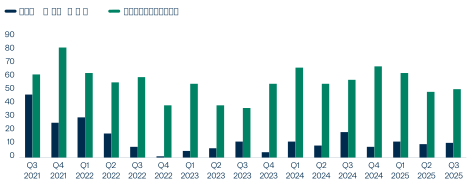
出所:ピッチブックLCD、2025年9月30日時点。プライベート・クレジットの案件数はLCD ニュースがカバーした案件に基づく。
As a result, borrowers are increasingly turning to private markets, which provide faster, more flexible and more reliable access to capital. For investors, this steady borrower demand translates into a robust pipeline with the potential for attractive risk-adjusted returns. Furthermore, direct lending structures typically sit senior in the capital stack and carry floating-rate coupons, helping to mitigate both default and interest-rate risk.
Pillar 2: ABF—Private Credit’s Next Frontier
Private ABF benefits from having similar dynamics to corporate private credit, but remains a relatively uncrowded opportunity set. ABF also has three key features that distinguish it from corporate private credit:
- Opportunity for consistent cash flows: Contractual cash flows from things such as loans, leases or royalties provide reliable repayment streams.
- Structural protections: Ring-fenced special-purpose vehicles (SPVs) and collateralization help insulate investors from corporate balance sheet issues.
- Spread premium potential: ABF typically offers a spread advantage versus both public asset-backed securities and corporate private credit of similar quality.
Pillar 3: The Case for Multi-Asset Credit
Investors are increasingly combining private credit with liquid performing credit, such as high-yield bonds. While private credit can offer a spread premium of 170-200 bps over public credit,3 liquid markets still provide compelling yields around 7%4—with greater liquidity.
A multi-asset credit strategy enables dynamic allocation across liquid and private markets, utilizing a broad range of credit instruments as market conditions evolve. To capture this potential, investors can benefit from working with managers who have experience identifying relative value and managing risk through market cycles.
From Opportunities to Allocation
As central banks recalibrate policy, the ability to reposition across the liquid credit spectrum—from high-yield bonds and senior loans to collateralized loan obligations (CLOs) and convertible bonds—will be essential for capturing income and managing risk dynamically.
Alternative credit is no longer about isolated opportunities. It is about building a resilient portfolio through active allocation across the credit spectrum (see below). Combining private and public credit can provide investors with the potential to capture enhanced yield along with the safety of robust contractual protections. It can also provide the available liquidity needed to adapt quickly to changing market conditions.
画像
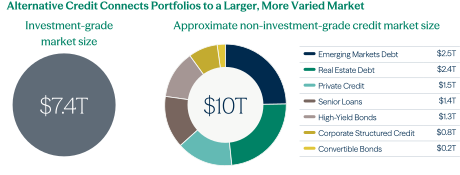
Source: J.P. Morgan, SIFMA as of December 31, 2024. U.S. market size represents the total amount of outstanding issuance.
Source: ICE BofA, Credit Suisse, J.P. Morgan, Bloomberg, Preqin data as of September 30, 2024. High-Yield Bonds represented by ICE BofA U.S. High Yield Constrained Index, Convertible Bonds represented by ICE BofA U.S. Convertibles Index, Senior Loans represented by Credit Suisse Leveraged Loan Index, Emerging Markets Debt represented by J.P. Morgan Corporate Emerging Markets High Yield Bond Index, Corporate Structured Credit represented by J.P. Morgan CLO Post-Crisis BB Index, Private Credit market size as reported by Preqin’s 2024 Global Report: Private Debt.
Bottom Line
Each of the above three pillars plays a distinct role: corporate private credit offers stable income potential; private ABF expands access to a growing, less-crowded market; and liquid credit provides the flexibility to adapt as conditions change.
Looking ahead to 2026, success may depend on active allocation and experience. Navigating across public and private markets requires a cycle-tested approach that seeks to convert opportunity into long-term portfolio resilience. We believe that alternative credit remains one of the most compelling areas for investors today, and that success in this environment requires a thoughtful active allocation strategy and rigorous risk management across a range of market environments.
Private Real Estate: Attractive Values—and Yields
Key Points
- Private real estate credit is offering a premium relative to other fixed-income products. While interest rates have moved lower due to recent Fed cuts, they are still elevated compared with the trailing five-year average, while real estate credit spreads remain elevated.
- Underlying property values are still below recent highs. This suggests an attractive entry basis for lenders.
- Long-term interest rates remain elevated.5 While short-term rates have come down slightly, long-term rates, which more directly impact real estate lending, remain elevated. Long-term rates are more sensitive to economic data, such as consumer spending and jobs reports, which are more likely to influence these medium- to long-term fixed rates than short-term interest-rate reductions.
- Positive outlook for transaction activity. As interest rates move lower, cash flow coverage increases, bringing down loan loss reserves for banks. Higher reserves can then be put back into the market and facilitate more commercial real estate lending and deal flow. Historically, greater transaction activity, after a lag, has led to higher property values over the long term.
Supportive Environment for Private Real Estate Debt
Given the potential for increasing volatility in global markets, strong current income from real estate debt can provide an attractive risk-adjusted option in investors’ portfolios, with the added benefit of hard-asset collateral.
To explore why, let’s take a look back at the interest-rate and macro backdrop first. In the period from 2022 to 2024, interest rates rose and property values fell (see below). This created opportunities to lend against commercial real estate (CRE) properties priced below their intrinsic value, thereby generating yield at an attractive basis.
画像
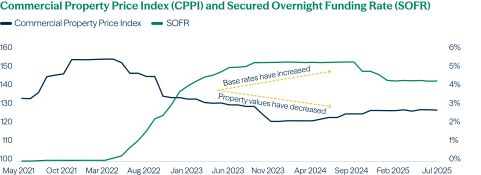
Source: Federal Reserve Bank of New York, Green Street CPPI, as of July 2025.
It also created a sizable funding gap, as lower real estate values and higher interest rates have reduced debt capacity, providing the opportunity for private lenders to originate debt and helping borrowers finance legacy capital structures.
Low property values and high interest rates have created the opportunity for lenders to generate yield at an attractive basis. Lenders have benefited from elevated rates in recent years, while today’s low values provide lenders with a cushion against potential loss. This is because lenders will be advancing less against current property values and, as a result, have a lower dollar basis, or exposure, against the underlying collateral property.
Loans originated at today’s property values are potentially protected from further value declines and should benefit from future value recoveries. Should property values decline further, loans originated at a discounted basis may benefit from the equity cushion ahead of their position. Conversely, as property values recover, today’s lenders would benefit from lower loan-to-value ratios, providing some safeguard from potential loss.
The combination of elevated interest rates and significantly reduced liquidity in the CRE debt capital markets has caused many borrowers to struggle to meet their debt service payments over the past two years, resulting in widespread extensions of loan maturities. There is still a significant amount of debt coming due that will need to be refinanced.
The trajectory of CRE debt maturities has continued to climb, with nearly $2T in maturities expected through the end of 2026, according to S&P Global. That surge of upcoming maturities with challenged capital structures will require financing at an attractive cost of capital and should provide a wide range of investment opportunities for private lenders.
The Real Estate Debt Advantage
Compared with real estate core equity, real estate debt has demonstrated consistent returns across cycles. During recent real estate value corrections, lenders’ positions were largely insulated from loss (outside of the office sector). Ultimately, private real estate credit provides an opportunity to seek consistent risk-adjusted returns while benefiting from the security of an equity cushion at the top of the capital structure.
Private real estate credit’s uncorrelated returns to core real estate equity illustrates the diversification benefits the asset class can provide to portfolios, which are arguably even more valuable in times of volatility.1
To find attractive return opportunities with reduced downside risks, we believe managers should use an equity lens to assess the underlying value. Managers that have comprehensive credit analysis capabilities and in-house operating platforms are well positioned to deliver many of the benefits of commercial real estate credit to investors, in our view.
Summing Up
In today’s volatile market environment, there is a compelling case for increasing allocations to private real estate credit, especially given its similar long-term return profile to core equity—with less downside risk. Amid market uncertainty, investors could benefit from elevated interest rates, high real estate spreads and low property values, all of which may position the real estate credit investor to potentially receive consistent, strong income yields for less risk than in prior cycles.
Infrastructure: Supported by Enduring Global Megatrends
Key Points
- The need for infrastructure investment continues to grow. At a time of ongoing global economic and geopolitical uncertainty, at least one economic reality persists: the need for infrastructure investment is growing.
- Three megatrends support infrastructure demand. The demand for greater investment in infrastructure is grounded in three global megatrends, or what we refer to as the “three D’s”:
- Digitalization. The development of AI will require the build-out of capital-intensive physical infrastructure.
- Decarbonization. Despite the rollback of incentives for renewable energy in the U.S., demand for diverse clean and renewable energy sources remains strong globally.
- Deglobalization. Onshoring of manufacturing and other industries continues to support significant investment opportunities going forward.
- These “three D’s” have been the core themes of infrastructure investment in recent times—and should continue into 2026 and for some time to come.
Investment Themes Driving the Three D’s
Digitalization: Today, AI is poised to become the most impactful general-purpose technology in history. It could transform industries—and life as we know it—through faster drug discovery, better healthcare diagnoses, autonomous vehicles, natural disaster predictions, home robotics care and more. Long term, AI has the potential to significantly reduce the marginal costs of producing essential resources, and lead to what many are calling the next industrial revolution.
Yet none of these breakthroughs will be possible without the build-out of capital-intensive physical infrastructure to support the adoption of AI. AI innovation is driving the need for massive infrastructure investment. This includes AI factories, power and transmission, “compute” (computational power) infrastructure and strategic adjacencies and capital partnerships—adding up to an investment opportunity of over $7 trillion over the next decade (see below).6
画像
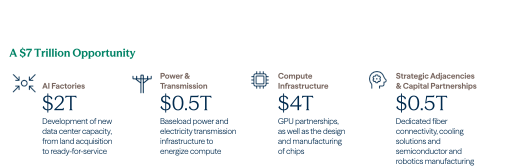
Source: Brookfield internal research, as of August 2025.
Decarbonization: Key clean-energy technologies continue to enjoy strong fundamentals, with favorable economics and rising technology maturity driving adoption in diverse geographies across the globe.
Renewable power provides a low-cost and quickly scalable source of power relative to other technologies.
Recent legislation in the U.S. may have rolled back some of the tax incentives to accelerate the build-out of renewable power. However, diverse clean and renewable energy sources, including technologies like hydro, nuclear and batteries, continue to play a critical role. Energy demand continues to outpace supply, creating a need for renewable power investment.
The power supply-demand imbalance is expected to further accelerate from the onshoring of manufacturing and the build-out of AI infrastructure projects. Renewable energy sources are among the best-positioned technologies to meet these evolving needs due to their lower cost, faster speed to market and provision of reliable and secure energy. As demand continues to grow for the foreseeable future, the grid is likely to become increasingly reliant on alternative energy sources to provide greater security.
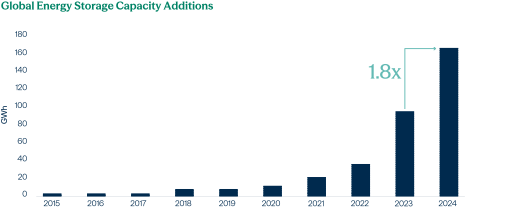
While renewable energy has emerged as the critical component to meet the enormous increase in demand, the world’s cheapest sources of new bulk power—solar and wind—come with a significant limitation: They’re intermittent. To address this challenge, batteries—specifically large-scale lithium-ion storage batteries—are charging ahead to play a vital role in the “any and all” approach to providing uninterrupted access to power.
With global energy storage capacity nearly doubling in 2024 (see below), batteries have become an essential infrastructure asset class, as much for their ability to increase renewable power penetration and help stabilize overburdened electricity grids as for the long-term revenue generated by the services they provide.
画像
Source: BloombergNEF, as of June 2025. For illustrative purposes.
Deglobalization: Finally, the onshoring of manufacturing and other critical industries may support significant investment opportunities going forward. With the addition of the U.S. administration’s new trade policies, a reduction in international trade volumes has taken place over the past few months, and increased pressure on supply chains is becoming more evident. The World Bank’s Global Supply Chain Stress Index (GSCSI) measures the magnitude of container shipping disruptions affecting global supply chains. The index is currently near levels last seen in 2022, when it spiked due to disruptions caused by the COVID-19 pandemic (see below).
画像

Source: World Bank, as of September 2025. Million TEUs represents millions of 20-foot equivalent units.
As a result, global trade patterns are evolving, driving the need for increased infrastructure investment at major coastal ports that serve as key gateway regions. Inland markets, with limited exposure to global trade but strong manufacturing bases, are well-positioned to benefit from a shift toward domestic production, but these bases will need continued investment to modernize and meet the growing demand.
Summing Up
A long-term investment horizon spanning multiple years, if not decades, is likely to be required for each of the megatrends, and visibility into new deployment opportunities continues to improve as this infrastructure supercycle progresses unabated. With a long history in both digital and energy infrastructure positions, Brookfield is well positioned to build out the physical backbone of AI. Our comprehensive experience spans decades of building railways, power grids and communication networks, which enabled the breakthroughs of past industrial revolutions.
Expertise in developing and operating critical infrastructure is essential to managing the risks involved. Experienced operators with an in-depth market understanding and access to key operational assets are better situated for success in this complex, highly specialized asset class.
Private Equity: Discipline, Credit and the Power of the Cycle
Key Points
- Mixed conditions temper the outlook. Private equity (PE) enters the final quarter of 2025 with mixed conditions that temper an otherwise constructive outlook.
- Headwinds: Tariffs, policy uncertainty and uneven exit activity are weighing on sentiment.
- Tailwinds: Credit markets are more supportive, with tighter loan spreads reducing interest expense, strengthening free cash flow and extending maturities.
- Fundraising remains selective: Limited partners (LPs) in PE firms are being more discerning, concentrating their commitments among larger managers while managing liquidity constraints.
What to Know About the PE Landscape Heading Into Q4 2025 and 2026
The PE landscape heading into the fourth quarter of 2025 and then 2026 is best described as a mixture of challenges and opportunities. Here’s what to know:
Crosscurrents are evident. Tariff headlines and uncertainty around the Fed’s policy path have cooled sentiment, after a strong start to the year. Exits remain uneven, and fundraising is subdued as LPs manage distribution backlogs. Much of the capital raised continues to flow to larger, established managers—an ongoing flight to quality.
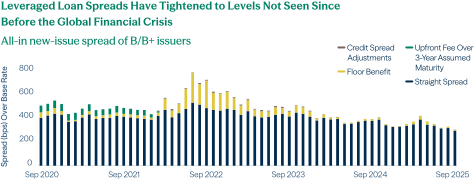
Financing tailwinds offer some balance. Leveraged loan spreads have tightened to levels not seen since before the Global Financial Crisis (see below). New B/B+ loans are pricing near SOFR+285, with many trading above par. Because debt is the primary funding source for PE transactions, this matters directly: lower spreads reduce interest expense, strengthen free cash flow and extend maturities.
画像
Source: PitchBook LCD; data through September 18, 2025. This analysis is provided for illustrative purposes only to demonstrate historical analysis on potential returns. Past performance does not guarantee future results.
Cheaper financing also supports new M&A by improving the feasibility of acquisitions, while giving buyers more confidence to transact. For existing portfolios, easier credit conditions can help unlock exit activity as sponsors and strategic acquirers regain financing capacity.
Lower borrowing costs don’t just improve balance sheets—they create the conditions for more active deal flow and can help restart exits.
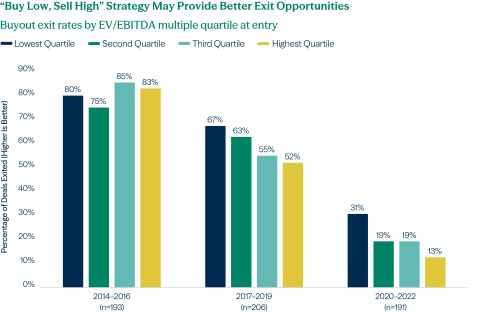
Discipline at entry still drives the outcome. PitchBook data highlights that entry valuation is closely linked to how quickly investments can be realized. Companies acquired at lower multiples have exited at materially higher rates than those bought at premium valuations (see below).
As exit markets begin to thaw, lower-valued deals are the ones most likely to transact first, returning capital to investors earlier. Higher-multiple deals, by contrast, often require longer holding periods or more creative structures to exit.
Disciplined entry pricing strengthens the foundation of an investment and improves the ability to distribute capital sooner when liquidity windows reopen.
画像
Source: PitchBook, as of September 20, 2025. This peer analysis is provided for illustrative purposes only to demonstrate historical analysis on potential returns.
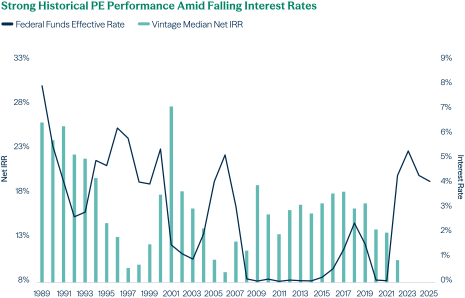
History shows the importance of timing across cycles. Preqin data on PE fund returns reveal a consistent pattern: the strongest outcomes occur when interest rates are falling—not just low, but declining (see below).
Deals completed in the early 1990s, early 2000s, after 2009, and post-2020 all fit this trend. Falling rates give a double boost: cheaper financing improves cash flow, while lower discount rates lift exit multiples. The combination magnifies outcomes for capital deployed into dislocated but recovering markets.
画像
Source: Preqin. Returns for vintage years 2022–2025 unavailable. As of September 30, 2025. This peer analysis is provided for illustrative purposes only to demonstrate historical analysis on potential returns.
Summing Up
As Q4 2025 unfolds, financing conditions are improving, and valuations are recalibrating. If further rate cuts materialize, PE deals raised during this period could benefit from the same tailwinds that powered some of PE’s strongest historical cycles. For investors with patience and discipline, the environment in late 2025 and into 2026 could potentially reward long-term positioning.
What 2025 Taught Us About Best Practices for Engaging Investors Around Alts
As we round out a year of traveling throughout the country, we are excited to share some recurring themes we’ve heard from advisors, clients and prospects. As high-net-worth (HNW) investors take a closer look at alternatives as a foundational part of their portfolios, advisors tell us that now is a critical time to provide clients with more education and insights into this growing asset class, especially given our breadth, scope and robust platform as one of the largest alternatives managers in the world.
This year, amid market uncertainty and economic shifts, some important lessons have emerged about how investors think about alternatives, what holds them back from investing, common misconceptions and the important role advisors play in opening the door to greater investment in alternatives.
Informed through our dialogue with clients and the proprietary research conducted by The Alts Institute among investors and advisors, we took a deeper dive into how advisors are framing the alternatives conversation, as well as what resonates most with HNW investors.
Here are five themes that are top of mind:
Flip the liquidity conversation: While interest in private markets continues to grow, investors need a stronger understanding of how liquidity really works in this space. About half of investors—including alts users and non-users—say they are comfortable sacrificing liquidity for growth. Yet for those investors currently using alts, the benefits are even clearer: nearly three-quarters of alts users believe that the outcomes that semi-liquid/illiquid alternative investments generate are worth the liquidity trade-off.
This signals that greater education can help non-users better understand that these assets are inherently long term and illiquid by nature. It’s important to communicate that increased access and product selection can enable investment in alternatives without the traditional 7-, 10- or 12-year lockups. We stress that these conversations should take place up front, so clients and prospects are comfortable with starting to allocate to these types of vehicles.
Reinforce investors’ long-term view: Private market valuations are typically assessed quarterly or semi-annually, by design. While transparency is a common investor concern, this reporting cadence can help investors stay disciplined and discourages reactions to day-to-day market swings. In fact, 95% of HNW investors say that when it comes to investing, they are focused on the long term.7
Even for investors not currently using alts, the vast majority say they are willing to ride out an investment’s volatility to achieve their investment goals over the longer term. For alts users and non-users alike, there is clear alignment between their forward-looking investing views and the potential for long-term value creation that alternatives may provide. Our conversations with clients back up what our research tells us: it is evident that most HNW investors, including non-users, are well-positioned for alts even if they don’t fully realize it.
Emphasize investment objectives over vehicles: As innovation expands access to private markets, investors are increasingly presented with a range of fund structures and vehicles. While these vehicles can enhance flexibility and accessibility, the real focus should remain on the investment objective.
Investors share that growth, income, capital preservation and diversification—all goals that can be well-served by various types of alternatives—are top priorities when evaluating investment opportunities. Ultimately, outcomes are driven by the underlying assets and manager expertise, not just the wrapper they come in, so elevating the investment objective can help investors see how alternatives fit within their broader investing goals. Alternatives are not a “one size fits all” solution.
Focus on the upside: Alts users recognize the clear upside potential of alternative investments, despite conventional wisdom suggesting that concerns over fees, transparency and liquidity are impediments to adoption. Most alts users believe that having an alternatives allocation will drive stronger long-term outcomes than a traditional portfolio; 79% of alts users believe those outcomes are worth the fees.
While alts investors tell us that they are overwhelmingly satisfied with the performance of their alternative investments, there is still work to do to address some of the perceived challenges.
Most HNW investors believe the industry could do a better job of explaining alts fees/expenses, and the majority of investors admit that they don’t know the right questions to ask about alternatives.
Show the big picture: Investors are looking to their advisors to lead the way, as 85% of investors would invest more in alternatives if their advisor recommended it.7 Investors want their advisor to guide them through their alts journey, focus on the overall benefit to the portfolio, explain products or strategies in depth and show how their strategies fit with their personal goals.
Investors are increasingly viewing alternatives as foundational to their portfolio strategy. They are also signaling that they need help thinking about their alternatives allocation in the context of their broader portfolio, particularly in an environment of heightened volatility and shifting market cycles. The good news is that resources exist, such as The Alts Institute, and advisors can and should lean into those resources.
The Advisor Opportunity
As private markets evolve, alternative investing education is more important than ever. Our research highlights that investors are increasingly seeking clarity on how alternative investing opportunities fit within their portfolios—a theme consistently reinforced throughout recent client interactions.
Moving forward, there is a compelling opportunity for advisors— particularly the next generation of advisors looking to reinforce their expertise—to reframe key elements of the alts discussion. By shifting the conversation to focus on outcomes, advisors will be able to better address investors’ distinct motivations, beliefs and concerns around alternatives. Through thoughtful guidance and education, advisors can empower their clients to more effectively navigate these complex structures and invest with confidence in this new era of alternative investing.
Read more in our Alts Quarterly Q4 2025.
脚注
1. 分散は、利益を保証するものではなく、市場下落局面における損失を防ぐものではありません。
2. プレキン、2025年9月30日時点。過去の実績は将来の結果を保証するものではありません。
リスクに関する記述
資産クラスとして、プライベート・クレジットは多様な債券で構成されています。それぞれのリスク/リターン特性は異なるものの、プライベート(非上場の)クレジット投資では、資金調達の選択肢が限定的な企業へのオポチュニスティックな投資を模索するため、一般的に、上場のものと比較してデフォルトリスクが高くなります。プライベート・クレジット投資では、通常、発行体が投資適格未満または無格付けであるため、より高いリスクの対価として利回りもより高くなります。
不動産関連商品への投資は、不動産の物件価値、賃料、入居率に影響を及ぼす経済、法令、環境の要因から影響を受ける場合があります。
インフラ企業は、その事業に悪影響を及ぼす可能性のある様々な要因(高金利、高レバレッジ、規制コスト、景気減速、余剰生産能力、競争激化、燃料不足、再エネ方針など)から影響を受ける場合があります。
オルタナティブ投資はしばしば投機的であり、高いリスクを伴います。投資家は、投資金額の全てまたは多額を失う可能性があります。ハイイールド債には金利リスクが伴います。金利が上昇すると債券価格は下落します。一般的に、満期が長期になるほど金利リスクに対する感応度が高くなります。利回りは経済状況に伴って変動します。利回りは、投資意思決定に際する検討事項のひとつにすぎません。
当資料に含まれる情報は、投資助言、取引意図もしくは保有銘柄の示唆または投資パフォーマンスの予測ではなく、そのように意図したものではありません。当資料に表示された見解および情報は、いつでも変更される場合があります。ブルックフィールドは、当該見解や情報を更新する責任を負いません。当該情報は信頼できる情報源から取得したものと見なされますが、ブルックフィールドは、その完全性または正確性を保証しません。
当資料で示された意見は、子会社および関連会社を含むブルックフィールドの現在の意見であり、予告なく変更される場合があります。子会社および関連会社を含むブルックフィールドは、当該情報の更新または顧客への変更の通知を行う責任を負いません。当資料に提示されたいかなる見通し、予測またはポートフォリオ保有比率も当資料に示された日付時点のものであり、予告なく変更される場合があります。過去のパフォーマンスは将来のパフォーマンスを示唆するものではなく、投資の価値とそれら投資から得られるインカムは変動することがあります。
将来の見通しに関する記述
当資料は、米国連邦証券法令、具体的に米国1934年証券取引所法(その後の改正を含む)第21E条、そしてカナダ証券法令における意義の範囲内における将来の見通しに関する記述を含む情報やそれらに基づく情報が含まれています。将来の見通しに関する記述は、事業戦略や投資戦略もしくは戦略遂行のための措置、競争力、目標、事業の拡大および成長、計画、見込み、将来の成功への言及など、将来の行動、事象または動向に関して、過去の事実の記述以外のすべての記述を含みます。これらの記述は、過去または現在の事実に厳格に関連しないという事実によって特定することができます。
「予測」、「推定」、「期待」、「予想」、「想定」、「計画」、「考え」やその他の類似する用語は、これらの将来の見通しに関する記述を特定するために用いられます。将来の見通しに関する記述は、不正確な仮定や既知もしくは未知のリスクおよび不確実性によって影響を受ける可能性があります。そうした要素の多くは、将来の実際の結果や成果を決定する上で重要となります。そのため、いかなる将来の見通しに関する記述についても保証はありません。実際の結果や成果は大きく異なることがあります。これらの不確実性を踏まえ、これらの将来の見通しに関する記述に不当に依拠するべきではありません。
ブルックフィールド·コーポレーションとその関係会社(総称して「ブルックフィールド」)が設定するいかなる商品に適用される条件の概要の提供を目的としたものではありません。情報および見解は予告なく変更される場合があります。当資料で提供される情報の一部は、ブルックフィールドの内部調査に基づいて作成されており、一定の情報はブルックフィールドによる様々な仮定に基づいており、いずれの仮定も正確とは限りません。ブルックフィールドは、当資料に含まれる情報(第三者から提供される情報を含む)の正確性または完全性を必ずしも検証しておらず(そして検証する義務を負わず)、いかなる情報についても検証されたものとしてブルックフィールドに依拠することはできません。当資料で提供された情報は、当資料作成時点におけるブルックフィールドの視点および信念を反映しています。
インデックス·プロバイダーに関する重要事項
当資料内で引用されたインデックスは運用されておらず、投資家がインデックスに直接投資することはできません。インデックスのパフォーマンスは例示のみを目的として記載されており、いかなる投資のパフォーマンスも予測または表示するものではありません。当該比較に関連して、記載されたインデックスとブルックフィールドの戦略、コンポジットまたはファンドへの投資との間には、ボラティリティや規制上および法律上の制約の違いなど、重大な要因が存在する可能性があります。ブルックフィールドは、第三者のインデックス·スポンサーからインデックスに関するすべてのデータを取得しており、当該データは正確と考えていますが、その正確性に関していかなる表明も行うものではありません。インデックスは運用されておらず、投資家が直接購入することはできません。
ブルックフィールドは、当資料で参照されたインデックスを所有しておらず、その構築または日々の管理に関与していません。当資料に記載されたインデックスの情報は、お客様への情報提供のみを目的としており、ブルックフィールドの運用商品が同様の結果を達成すると暗示または予測するものではありません。当該情報は予告なく変更されることがあります。当資料で参照されたインデックスは、いかなる報酬、費用、販売手数料または税金も控除していません。インデックスに直接投資することはできません。インデックス·スポンサーは、インデックスおよび関連データの「現状のまま」での使用を許可しており、これに関していかなる保証も行わず、インデックスまたはインデックスに含まれる、関連する、もしくはそこから派生するデータの適合性や品質、正確性、適時性、完全性を保証せず、それらの使用に関連して一切の責任を負いません。インデックス·スポンサーは、直接的、間接的、特別、偶発的、懲罰的、結果的またはその他の損害(利益の損失を含む)について一切の責任を負いません。インデックス·スポンサーは、ブルックフィールドまたはそのいかなる運用商品やサービスの後援、是認または推奨も行うものではありません。別段の注記がない限り、全てのインデックスはトータルリターン·インデックスです。
主要な用語とインデックスの定義
ブルームバーグ・グローバル総合インデックスは、世界中で取引されている投資適格債券で構成される時価総額加重インデックスです。同インデックスには、市場の債券ユニバースを疑似する政府証券、モーゲージ担保証券、資産担保証券、社債が含まれます。同インデックスを構成する債券の満期は1年以上です。
ブルームバーグ米国ハイイールド債インデックスは、米ドル建て固定金利ハイイールド債市場のパフォーマンスを測定する指数です。ムーディーズ、フィッチ、S&Pによる格付けの中間がBa1/BB+/BB+またはそれ以下の場合、ハイイールド債として分類されます。
クリフウォーター·ダイレクト·レンディング·インデックス(CDLI)は、特定の適格性要件を条件として、上場および未上場の両方を含む事業開発会社(BDC)の原資産の資産加重パフォーマンスで表される、米国ミドルマーケット(中堅)企業貸付のレバレッジなし報酬控除前パフォーマンスを測定する指数です。
FTSE EPRA Nareit ディベロップト不動産インデックスは、運用されていない時価総額加重トータルリターン·インデックスであり、先進国の上場エクイティ·リートおよび上場不動産企業で構成されています。
FTSEグローバル·コア·インフラストラクチャー50/50インデックスは、市場参加者に業界の定義によるインフラの解釈をもたらし、一定のインフラ·サブセクターへのエクスポージャーを調整しています。セクター別構成比率は、半年ごとのレビューの一環として、広範な3産業セクターについて、公益事業50%、7.5%を上限とする線路/鉄道を含む運輸30%、パイプライン、衛星、電気通信塔を含むその他セクター20%の比率に従って調整されます。各グループ内の個別銘柄の比率は、投資可能時価総額の割合で調整されます。
グリーン・ストリート商業用不動産価格インデックス(CPPI)は、米国の商業用不動産の価値を追跡するグリーン・ストリート社が公表する時系列指数です。この指数は、オフィス、工業、商業施設、多世帯住宅など主要セクターにおける機関投資家向け物件の取引価格と鑑定評価に基づいています。時間の経過に伴う商業用不動産価値の変動を示すベンチマークとして広く利用されています。
ICE BofA シングルB米国ハイイールド指数は、米国内市場で公募された米ドル建ての投資適格未満の企業債券(格付けがBの銘柄を含む)のパフォーマンスを追跡する指数です。
ICE BofA 米国コンバーチブル指数は、米国における転換社債のパフォーマンスを追跡する指数です。
JPモルガンCLO ポスト・クライシスBBインデックスは、JPモルガンCLOインデックスのうち、BB 格付の CLO のみを対象としてパフォーマンスを追跡するサブ指数です。
JPモルガン・エマージング・マーケッツハイイールド・ボンド・インデックスは、新興国の企業、政府、政府関連機関が発行する米ドル建ての固定金利・変動金利債のうち、流動性のあるハイイールド債のパフォーマンスを追跡する指数です。
MSCI ワールド·インデックスは、先進国の株式市場のパフォーマンスを測定するように設計された、浮動株調整後時価総額加重インデックスです。
ナスダック指数は、ナスダック株式市場で取引されている企業を時価総額加重方式で追跡する指数です。
プレキン·インフラストラクチャー·インデックスは、プライベート·キャピタル·パートナーシップへの実際の投資額に基づいて、投資家がプライベート·インフラ·ポートフォリオで平均的に獲得したリターンを指数化したものです。各データポイントは、包括的なパフォーマンスデータが保有されているクローズドエンド型ファンドのプールから、四半期開始時点と終了時点の両方で個別に算出されています。
プレキン·プライベート·エクイティ·インデックスは、プライベート·キャピタル·パートナーシップへの実際の投資金額に基づいて、投資家がプライベート·エクイティ·ポートフォリオで平均的に獲得したリターンを指数化したものです。各データポイントは、包括的なパフォーマンスデータを保有するクローズドエンド型ファンドのプールから、四半期開始時と終了時の両方で個別に算出されています。
プレキン·リアル·エステート·インデックスは、プライベート·キャピタル·パートナーシップへの実際の投資金額に基づいて、投資家がプライベート不動産ポートフォリオで平均的に獲得したリターンを指数化したものです。各データポイントは、包括的なパフォーマンスデータが保有されているクローズドエンド型ファンドのプールから、四半期開始時点と終了時点の両方で個別に算出されています。
S&P 500指数は、幅広く保有されている米国の大企業500社の時価総額加重平均株価指数です。
S&P UBS レバレッジド・ローン・インデックスは、米ドル建てレバレッジド・ローンの投資可能なユニバースを対象に、市場価値加重ベースでそのパフォーマンスを測定する指数です。
担保付翌日物調達金利(SOFR)は、米国債を担保とした翌日物資金調達コストを幅広く示す指標で、ニューヨーク連邦準備銀行が公表しています。SOFRは米国債レポ市場における実際の取引データに基づいて算出され、短期金利のベンチマークとして信頼性が高いとされています。現在、多くの金融契約で LIBOR に代わる主要な参照金利として利用されています。
世界サプライチェーン・ストレス指数(GSCSI)は、世界の供給網における混乱やストレスの度合いを測定するために世界銀行が開発した指標です。コンテナ輸送量、輸送コスト、遅延などのデータを統合し、供給網のボトルネックやそれが世界貿易に与える影響を定量的に評価します。国際物流や製造業に影響を与えるトレンドやショックを把握するためのモニタリング指標として利用されています。
B-829554